
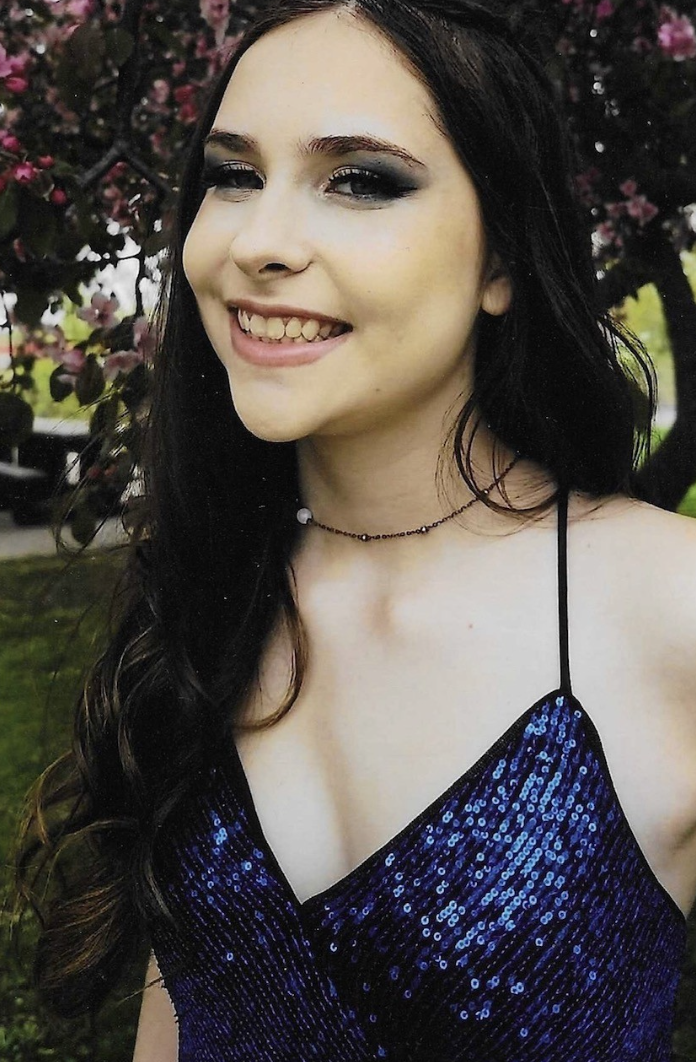
Jeyda’s journey as told by her mother – Jeyda Armstrong is a 17-year-old girl from Charles City. She recently graduated from CCHS in May 2026. Jeyda lives with her mom, Stacie, her stepdad Kyle, and her little brother Axel. She also has an older brother, Ethan and 2 stepsisters: Zoey an Piper that reside in Mason City.
When Jeyda was just a year old, her father Anthony Armstrong, just 27 years old at the time, was diagnosed with a rare, genetic neurological disease, called Huntington’s Disease. They soon realized life would look very different. Huntington’s Disease is a fatal disease with no cure or treatment. When Jeyda was 5 years old and in kindergarten, her daddy sadly passed away at the age of 31. That loss was extremely hard on Jeyda as she was truly “daddy’s girl.”
Through the years, I always knew my children had a 50% chance of inheriting this horrible disease. But I tried to remain hopeful through it all. In the Fall of 2025, Jeyda’s older brother, Ethan, had tested negative for HD. However, around that same time, we started noticing changes in Jeyda. Her stability was off. Her ability to comprehend and learn things was not normal. She’d always been a clumsy girl, but it was worse than the normal. I got Jeyda into the U of I Hospitals immediately to have her evaluated.
In May 2026, Jeyda was seen by the Neurologist t U of I and they informed us that Jeyda was in fact showing significant signs of JHD. Tests were immediately set up to confirm.
Very recently on July 31, I took Jeyda to the U of I hospital for what I thought was just going to be testing. She saw a neurologist who specialized in Huntington’s Disease, along with a genetic counselor and a HD psychiatric specialist – all that same day.
The neurologist informed us that she would be able to make a professional diagnosis based on her family history and the symptoms she was showing. After 50 minutes of observation including physical testing, she was diagnosing Jeyda with Juvenile Huntington’s Disease. She stated she was well into motor manifestation. That certainly was not the news we were prepared to hear that day.
HD is a rare disease, but JHD is even rarer. Less than 10% of HD cases are JHD cases. Because of its rarity, most physicians may only encounter 1 patient if any during their career.
JHD causes many things to happen. It causes involuntary movements, seizures, memory loss, physical pain, weakened immune system, and is terminal. A person with JHD progresses more rapidly than a person with HD. JHD has a lifespan of 10-15 years after onset of symptoms.
Our family is devastated. This has been my greatest fear for years. Right now, we are just trying to give Jeyda the best life we can. Yesterday, Lisa with My Happy Place reached out to us to let us know that Jeyda was chosen to receive a bedroom makeover. Jeyda was nominated by her grandmother, Denise Thomas. We were actually together at the time the call came in. We both cried many happy tears as we knew this would cheer her up.
Jeyda’s room is her sanctuary. When I told Jeyda the good news, she was so excited she started looking up ideas right away. The smile that was on her face will be one I will never forget. For a few hours that day, joy took the lead, and JHD stepped quietly into the background.
Recent Comments